Introduction
It feels like we only recently adapted to Wi-Fi 6 and Wi-Fi 6E. But in the technology world, innovation never sleeps. As we approach the end of 2025, a new standard has officially taken center stage: Wi-Fi 7 (IEEE 802.11be).
Many people might think, “It’s just another speed upgrade.” While it is true that Wi-Fi 7 is significantly faster, if you are a Network Engineer or a tech enthusiast, you’ll realize that the primary focus of Wi-Fi 7 isn’t just raw speed—it’s capacity, reliability, and latency.
Here is why Wi-Fi 7 is being hailed as a genuine game-changer for modern network infrastructure.
What is Wi-Fi 7?
Wi-Fi 7, technically known as IEEE 802.11be Extremely High Throughput (EHT), is the latest generation of wireless standards. If Wi-Fi 6 was built to handle device density (IoT), Wi-Fi 7 is built for extreme performance.
Theoretically, Wi-Fi 7 can hit speeds of up to 46 Gbps. For comparison, Wi-Fi 6 maxes out at roughly 9.6 Gbps. However, these speed numbers are just the tip of the iceberg. The real magic happens under the hood.
Key Features: What Makes Wi-Fi 7 Special?
Three main technological pillars make Wi-Fi 7 vastly superior to its predecessors:
1. Multi-Link Operation (MLO) – The Star Feature This is the most revolutionary feature. In previous Wi-Fi standards (Wi-Fi 6/5), a device could only connect to one frequency band at a time—either 2.4GHz or 5GHz.
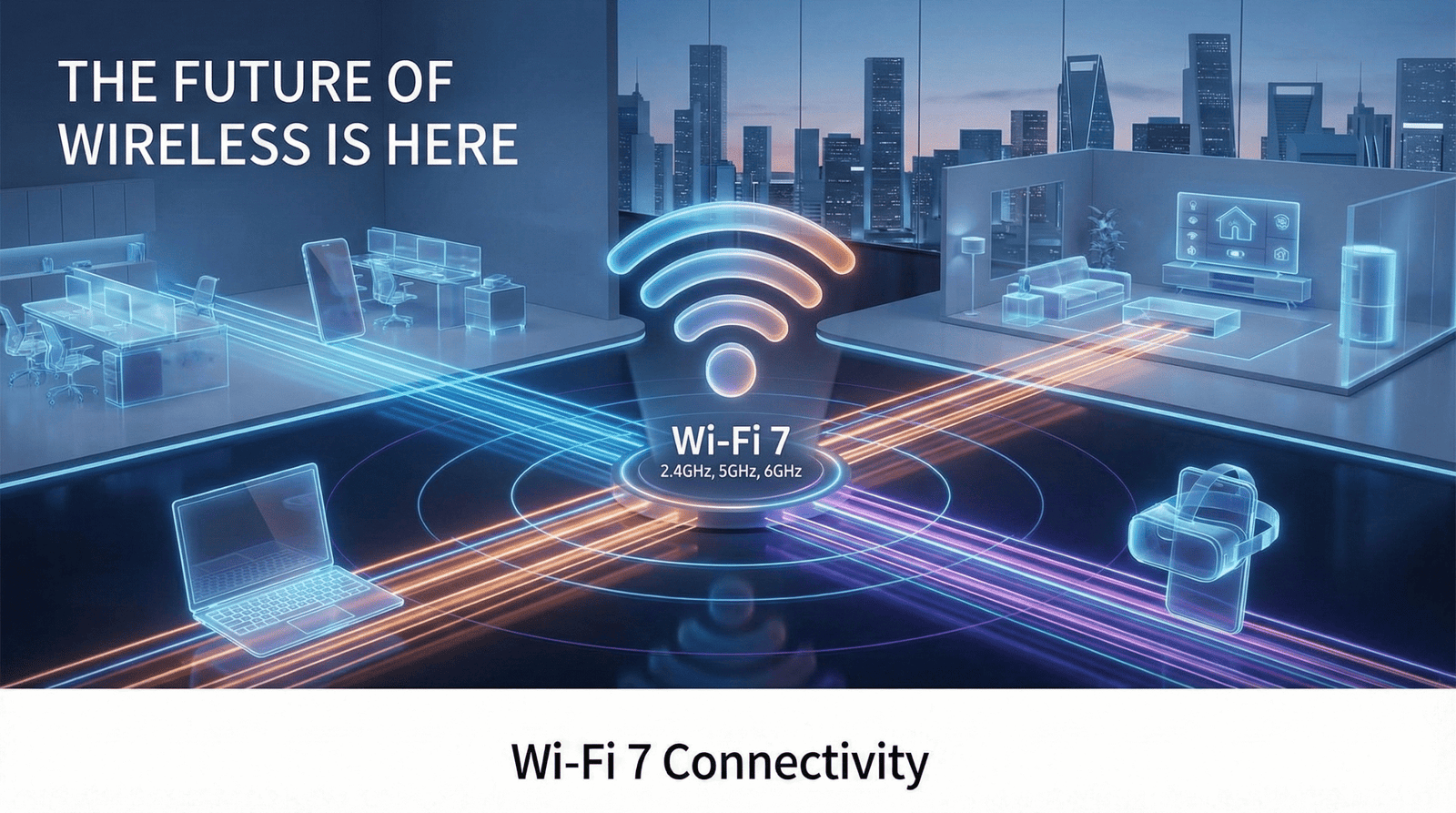
With MLO, a Wi-Fi 7 device can connect to multiple bands simultaneously (2.4GHz, 5GHz, and 6GHz).
- The Analogy: Imagine a highway. Old Wi-Fi forced your car to choose one lane. If that lane got jammed, you were stuck. MLO allows your car (data) to use two or three lanes at the same time. If one lane is congested, data instantly shifts to another without dropping packets, or it uses both to double the throughput.
- The Result: Ultra-low latency and a much more stable connection.
2. Ultra-Wide 320 MHz Channels Wi-Fi 6E introduced the 6GHz band with channel widths up to 160 MHz. Wi-Fi 7 doubles this to 320 MHz. The wider the channel, the more data can pass through at once. It’s essentially upgrading the highway from 4 lanes to 8 lanes.
3. 4K QAM (Quadrature Amplitude Modulation) Without getting too deep into signal processing, 4K QAM allows each signal waveform to carry more data (bits) compared to the 1024-QAM used in Wi-Fi 6. This upgrade provides a purely efficient data boost of around 20%.
Who Actually Needs Wi-Fi 7?
Do you need to rush out and replace your home router immediately? Perhaps not yet. But for the following scenarios, Wi-Fi 7 is becoming a requirement:
- High-Density Offices: In corporate environments where hundreds of laptops are on Zoom calls simultaneously, MLO prevents the bottlenecks that frequently plague older Wi-Fi standards.
- Gamers and Streamers: For competitive gamers, the enemy isn’t download speed; it’s latency (lag). Wi-Fi 7 offers latency metrics that rival wired Ethernet connections.
- AR/VR Technologies: Virtual Reality headsets require massive data transfer in real-time without cables. Wi-Fi 7 is the key to unlocking a seamless, wireless VR experience.
Adoption Challenges
While it sounds incredible, Wi-Fi 7 adoption comes with one major caveat: Client Devices. Owning a high-end Wi-Fi 7 router is useless if your laptop or smartphone is still running a Wi-Fi 5 or 6 chip. However, with the launch of flagship smartphones and laptops throughout 2025, support for this standard is rapidly flooding the market.
Conclusion
Wi-Fi 7 is not just a routine annual update. By enabling frequency aggregation through MLO, it solves the biggest problems of wireless connectivity: stability and latency.
For those planning network infrastructure upgrades for offices or smart homes looking 5 years into the future, Wi-Fi 7 is a sound investment. The future of the internet is wireless, and Wi-Fi 7 ensures that “wireless” finally feels just as reliable as a cable.