Introduction
For the past two years, the technology sector has been fixated on Generative AI. We have marveled at Large Language Models (LLMs) that can write complex code, draft poetry, and create photorealistic images from a simple text prompt. It was a period of discovery.
However, as we approach the end of 2025, the novelty of “chatting” with a machine is fading. The conversation is shifting from generation to execution. We are no longer just asking AI to think for us; we are asking AI to do things for us.
Welcome to the era of Agentic AI.
What is Agentic AI?
To understand Agentic AI, we must distinguish it from the chatbots we have grown accustomed to.
- Passive AI (Generative): You ask a question, and the AI provides an answer based on its training data. It waits for your input.
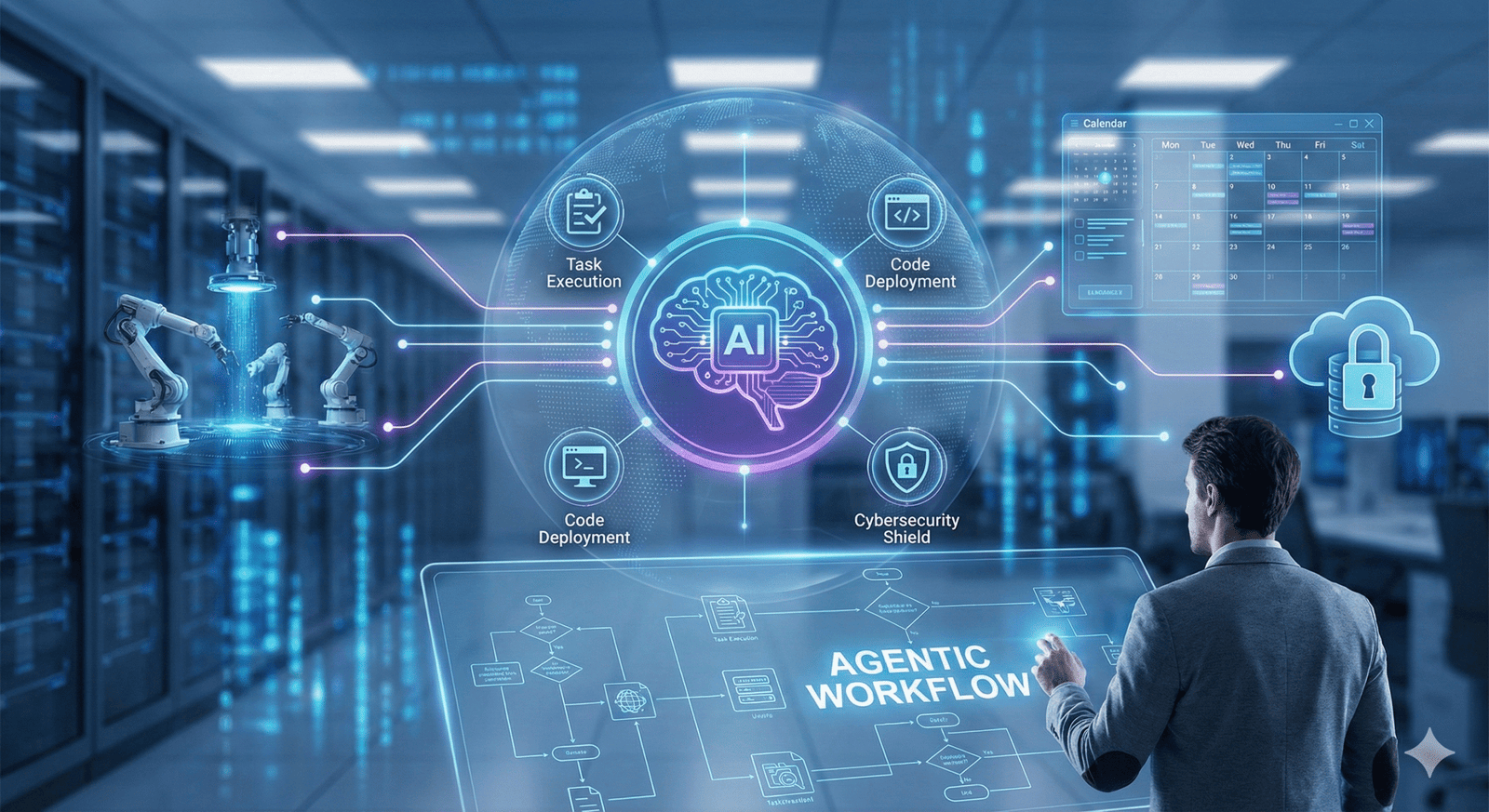
- Active AI (Agentic): You give the AI a goal (e.g., “Plan a travel itinerary under $2,000” or “Optimize this network configuration”), and the AI autonomously figures out the steps, uses tools, browses the web, and executes the necessary actions to achieve that goal.
Agentic AI systems possess agency—the capacity to act independently in an environment. They don’t just suggest a line of code; they can write it, debug it, test it, and potentially deploy it.
Key Drivers Behind the Trend
Why is this happening now? Three main factors are converging in late 2025:
- Model Reasoning: The latest foundation models have significantly improved reasoning capabilities. They can break down complex problems into smaller, manageable steps (chain-of-thought) without human hand-holding.
- Tool Use (Function Calling): AI models are now seamlessly integrated with external APIs. They can read your calendar, access CRM databases, and interact with software environments directly.
- Enterprise Demand: Businesses are moving beyond “AI for content creation” to “AI for operational efficiency.” They need systems that can handle end-to-end workflows, not just draft emails.
The Impact on Cybersecurity
With great power comes great responsibility—and significant risk. The rise of autonomous agents introduces new attack vectors that IT professionals must address.
If an AI agent has the permission to execute financial transactions, modify cloud infrastructure, or send communications on your behalf, the security protocols surrounding that agent must be ironclad. Zero Trust architecture is no longer a buzzword; it is a necessity for safe AI deployment. We are seeing a rise in “Agent Identity Management,” ensuring that every action taken by an AI is authorized, logged, and verifiable.
Looking Ahead: The Human-in-the-Loop
Does this mean humans are obsolete? Far from it. The role of the human worker is evolving from “creator” to “manager.”
In an agentic world, humans will act as supervisors or orchestrators. We will set the goals, define the boundaries, and review the outcomes. The skill set required for the future is not just prompting, but evaluating—understanding whether the AI’s logic is sound and its actions are aligned with ethical and business standards.
Conclusion
The leap from Generative to Agentic AI represents a fundamental change in how we interact with technology. It promises to unlock a level of productivity we have only dreamed of, but it demands a robust infrastructure and a serious approach to security.
As we look toward 2026, the question is no longer “What can AI create?” but rather “What can AI achieve?”